

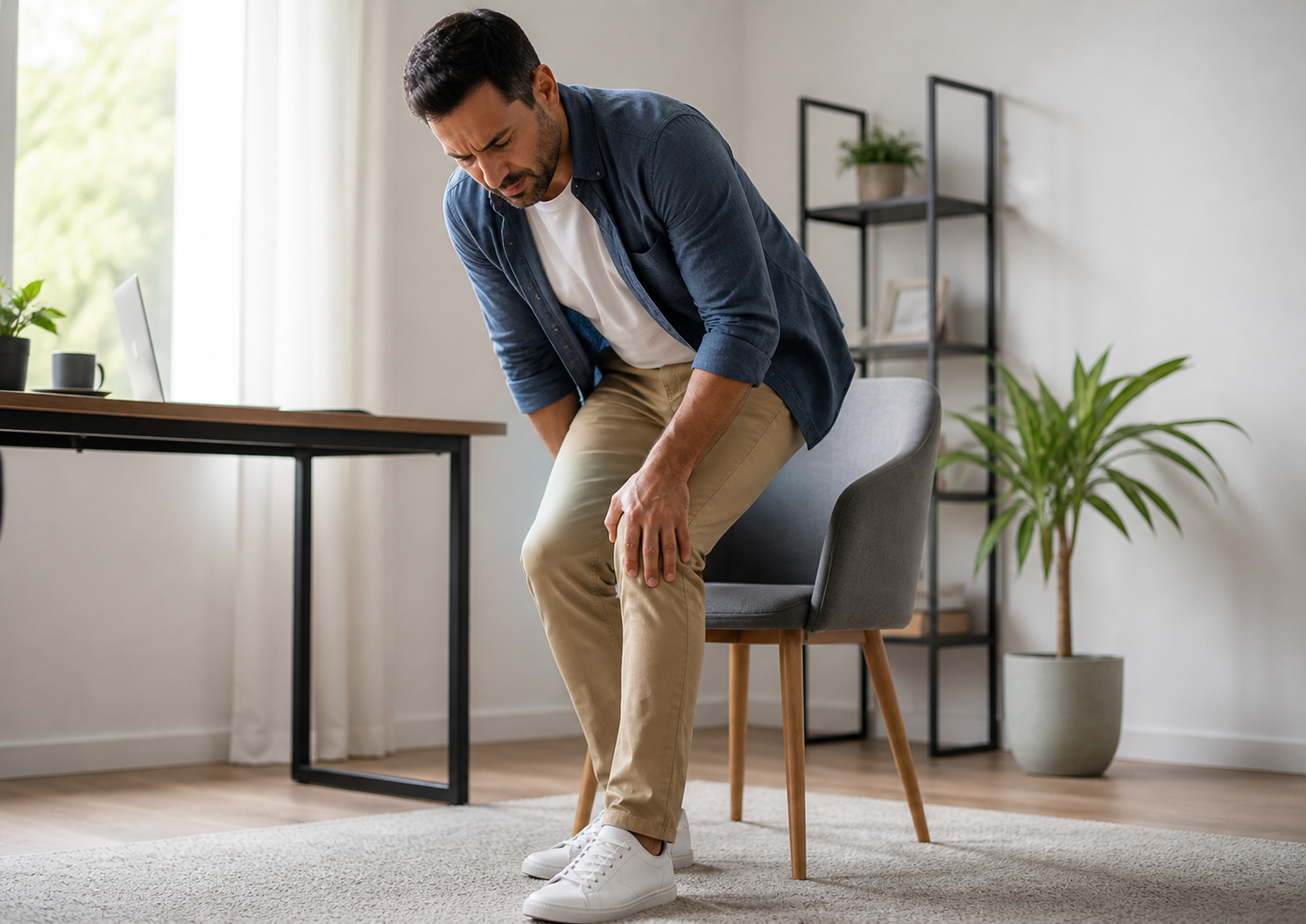
You stand up after watching TV, working at your desk, or driving for a while… and there it is.
That stiff, achy, awkward knee pain that makes your first few steps feel way older than you are.
If that sounds familiar, you’re not alone. A lot of people notice their knee feels worse after sitting still for too long, then gradually loosens up once they start moving. It can be annoying, confusing, and sometimes a little concerning especially when you’re not sure if it’s “just stiffness” or something more.
The good news? This is a really common pattern, and in many cases, it’s your body giving you a clue, not a reason to panic.

Dr. Jacob Tomlinson
Physical Therapist
Why knee pain often shows up after sitting
When you stay in one position for a while, your knee joint is not moving through its normal range. That can lead to stiffness in the joint, surrounding muscles, and connective tissue. Blood flow is lower, the joint gets less motion, and the structures around the knee can become more sensitive when you finally get up.
For some people, the problem is less about damage and more about how the knee is tolerating load and movement.
That’s why your first few steps may feel rough, but then things start easing up once the joint warms up again.
Common reasons your knee hurts after sitting
There isn’t just one cause, but here are a few common possibilities:
1. Joint stiffness
This is one of the most common reasons. If the knee stays bent for a long time, it can feel tight and uncomfortable when you first straighten it again.
2. Irritation under the kneecap
Pain around or behind the kneecap often shows up when sitting for long periods, especially if the knee is bent the whole time. Some people notice this during long car rides, movies, or desk work.
3. Weakness in the hips and legs
If your muscles are not supporting your movement well, your knee may take on more stress than it should. Sitting for long stretches can make that stiffness and weakness feel even more obvious when you stand.
4. Early arthritic changes
In some cases, pain after sitting can be related to wear-and-tear changes in the joint. That does not automatically mean something is severe, but it does mean your knee may need better support, strength, and movement strategies.
5. Reduced tolerance to activity
Sometimes the knee becomes more sensitive simply because it has gotten deconditioned. When joints and muscles are not moving enough, even normal daily tasks can start to feel uncomfortable.
A simple question to ask yourself
Does your knee only hurt when you first get up, then calm down after a minute or two?
That pattern often tells us the issue may be more related to stiffness, irritation, or reduced movement tolerance than a major injury. It is still worth paying attention to, but it also means there’s usually a lot we can do to help.
What you can do right now
Here are a few practical things that may help:
Break up long sitting periods
Try not to stay in one position too long. Even standing up for a minute or two every 30 to 60 minutes can make a difference.
Gently move before standing
Before getting up, try straightening and bending your knee a few times. A little movement can help reduce that “stuck” feeling.
Build strength
Your knee usually feels better when the muscles around it are doing their job. Strengthening the quads, glutes, and hamstrings can improve how your knee handles daily life.
Pay attention to patterns
Notice when it happens most. Is it worse after driving? Office work? Sitting cross-legged? These details can help identify what your knee is responding to.
When should you be more concerned?
Knee pain after sitting is often manageable, but you should pay closer attention if you notice:
- swelling
- locking or catching
- giving way
- sharp pain that keeps getting worse
- pain that does not improve once you start moving
- trouble walking normally
Those signs do not always mean something serious, but they do mean it is worth getting checked.

The bigger picture
A painful knee does not always mean a damaged knee.
Sometimes it means your body needs more movement.
Sometimes it means your strength is not where it needs to be.
Sometimes it means the joint is getting irritated by the way you sit, move, or load it throughout the day.
The key is not to ignore it and hope it magically disappears, but also not to assume the worst.
At Ascend Physical Therapy, we help people figure out why their knee pain keeps showing up and what to do about it so they can get back to moving with confidence.
Not sure what your knee pain is telling you?
A great place to start is our Knee Pain Quiz. It can help you better understand what may be driving your symptoms and what your next step should be.
And if you’re tired of guessing, book an Initial Evaluation. We’ll take a closer look, find the real issue, and create a plan that actually makes sense for you.
You can also explore more knee pain resources on our blog, including:
- Why Does My Knee Hurt Going Up or Down Stairs?
- Knee Pain When Walking: Causes and When to See a Physical Therapist
- Why Your Knee Pain Keeps Coming Back (Even After Rest)
- Why Does My Knee Hurt When I Bend It or Squat
ASCEND PHYSICAL THERAPY LLC
101 Tennessee Way STE 300, Hendersonville, TN 37075, United States

Leave a Reply