

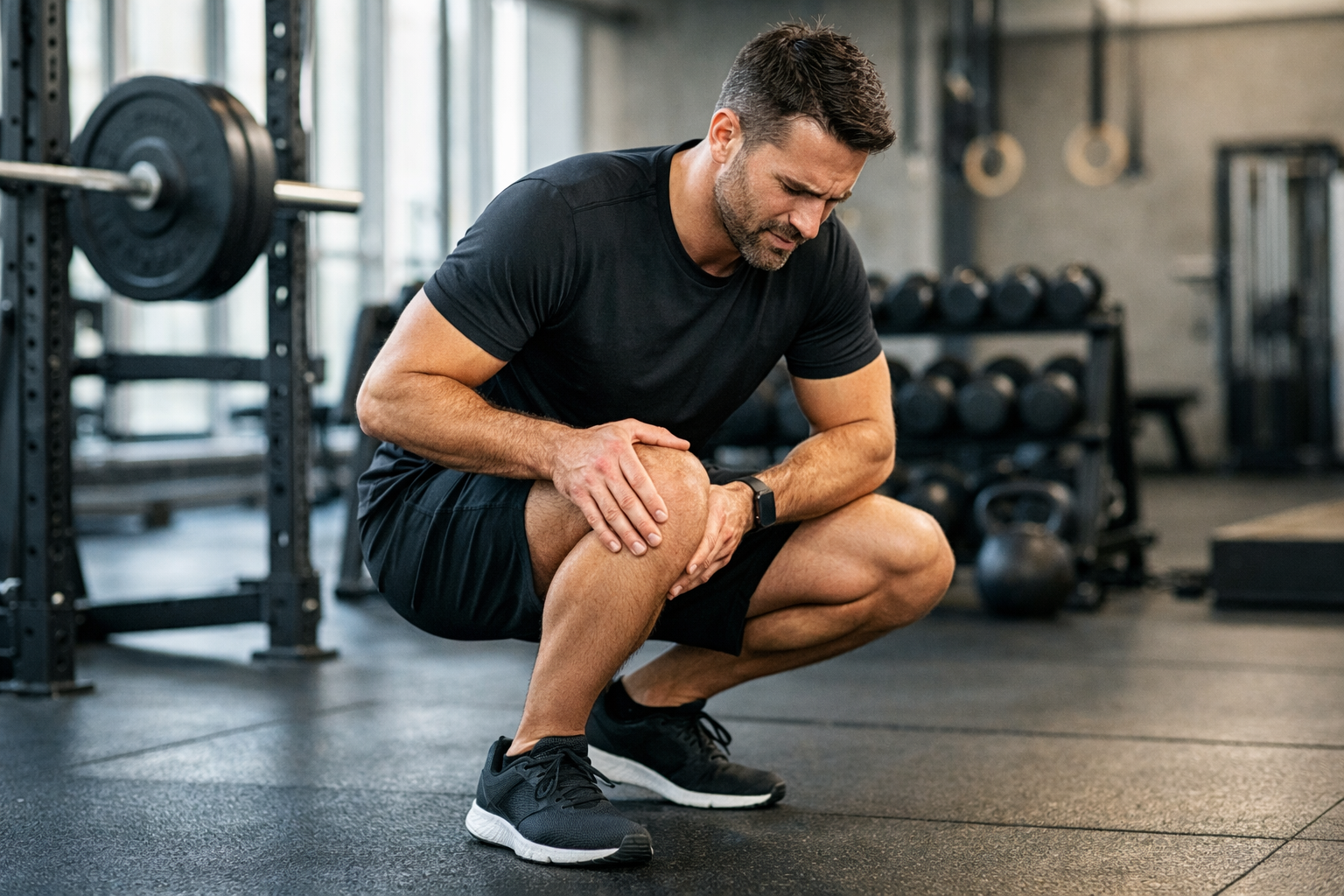
“The first 2 set are fine – it’s the last set that kills my knees.”
If you relate to this, your knees are not broken.
And squats are not the enemy.
Most people assume “my knees just don’t like squats.”
But more often than not, it’s not that your knees hate squats…
Your knee just might be the weakest link taking all the fire.
The Long-Term Fix
The long-term fix isn’t a magic stretch, a brace, or a new pair of shoes.
For our clients, we take them through our simple 3 – Step Iron Squat Progression: calm things down first, clean up the weak links in the chain, and then gradually build the kind of strength your knees can rely on.
This 3-Step Iron Squat Progression has helped active Hendersonville residents return back to CrossFit, Hyrox, Krav Maga, and Powerlifting – pain free.
1. Reduce Irritation (temporarily)
If your knees are flared up, the goal isn’t to stop training- it’s to reduce the dose that’s irritating them. Modern rehab research supports load management, not total rest. That means keeping pain in a tolerable range (mild to moderate is usually okay) and making sure it settles within 24 hours. If it lingers or worsens the next day, you did too much.
Instead of ditching squats entirely, adjust:
- Reduce depth (box squat or stop just before the painful range)
- Reduce load by 10-25%
- Reduce volume or frequency
- Slow the tempo (control the descent, avoid dive-bombing)
This phase isn’t the fix – it’s how you calm things down so you can start rebuilding real knee capacity.
2. Fix the Upstream Leaks
If your knees hurt when you squat, the problem often isn’t the knee itself. It’s what’s happening above or below it. When surrounding joints can’t do their job, the knee absorbs extra stress. Over time, that shows up as irritation, pressure under the kneecap, tendon pain, or that unstable feeling at the bottom of a squat.
Here’s why upstream issues matter:

- Limited ankle mobility → forces the heel to lift or the torso to pitch forward, increasing stress on the front of the knee.
- Weak or poorly controlled hips → allows the femur to rotate inward, increasing knee valgus and patellofemoral compression.
- Poor eccentric control → leads to bouncing, shifting, or collapsing into the bottom position, which spikes joint stress.
- Side-to-side asymmetry → makes one knee consistently absorb more load than the other.
If those leaks aren’t addressed, the knee keeps paying the price – no matter how much you stretch it or brace it.
3. Build Back Knee Strength
This is the stage that requires specific exercises for your unique knee issue. If you skip this step, you’ll likely end up right back in the same cycle. Flare it up, calm it down, repeat.
That’s not a knee problem. That’s a programming problem.
Random rehab exercises are one of the fastest ways to irritate a sensitive knee again. Different pain patterns require different loading strategies. Some knees need more quad strength in deeper ranges. Others need controlled tendon loading. Others need better single-leg stability before returning to full squats. If the exercise doesn’t match the problem, it won’t build real strength and tolerance. It just makes the pain worse.
That’s exactly why we created the Knee Pain Quiz. It identifies your specific knee pattern and gives you exercises that fit your situation – not cookie-cutter rehab exercises.
4. (Bonus) Reload
Once your knee is calm and you’ve rebuilt real strength, it’s time to ramp back up – gradually. Don’t jump straight to your old working weight. Start with a load you can control pain-free and rebuild confidence under the bar. The goal is steady exposure, not a PR day.
When reloading:
- Start lighter than you think you need
- Control the tempo (no dive-bombing)
- Leave 2–3 reps in reserve
- Progress weight slowly week to week
- Monitor how the knee feels the next day
Reloading correctly ensures you return to your previous squat weight pain-free.
Only this time, with better mechanics and stronger knees than before.
Closing
Knee pain with squats doesn’t mean you have to rack the bar for good. Following our 3-Step Iron Squat Progression ensure squats stop being the thing you dread and start being the biggest unlock for your lower body strength.
P.S. Take the Knee Pain Quiz and get specific exercises for your knee pain recovery.


Leave a Reply